

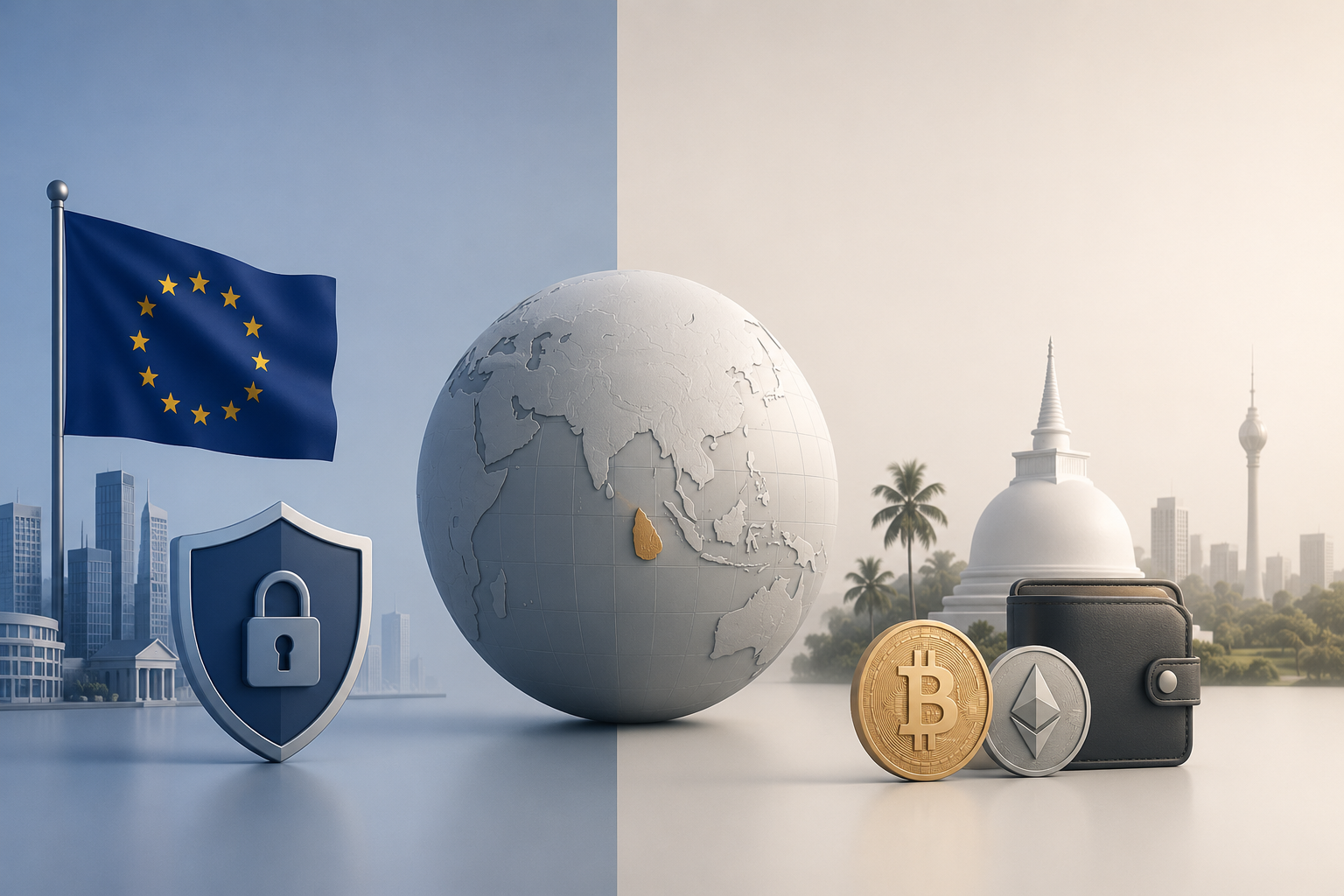
MiCA & Sri Lanka: What Every Crypto User Should Know
A CeylonCash Digital Assets Intelligence Team Brief
The European Union's Markets in Crypto-Assets (MiCA) regulation reached its final implementation milestone on 1 July 2026, requiring crypto service providers operating in the EU to hold a MiCA licence. While Sri Lanka is not subject to MiCA, its effects are already being felt globally because many Sri Lankans use international exchanges that serve European customers. (ESMA)
Before You Dive In
- MiCA is an EU regulation. It does not directly regulate Sri Lankan individuals or businesses operating solely in Sri Lanka.
- If you use an exchange with European operations, you may notice changes to KYC requirements, supported assets, withdrawal processes, and product availability.
- MiCA reinforces an important lesson: regulation can strengthen custodial services, but it does not replace the benefits of self-custody.
How MiCA Could Affect Sri Lankans
1. Exchange Availability May Change
Some global exchanges have decided to restructure or discontinue services in parts of Europe because of MiCA licensing requirements. Even if you live in Sri Lanka, changes to a platform's global operations may impact available products or supported jurisdictions. (euronews)
 Quirino Mealha
What to do
- Stay updated with announcements from your exchange.
- Avoid keeping all assets on a single platform.
- Always maintain access to an alternative exchange and your own wallet.
2. Stronger Compliance Will Become the Global Standard
MiCA introduces stricter requirements around:
- Customer identification (KYC)
- AML and CFT controls
- Asset segregation
- Consumer protection
- Operational resilience
Many global exchanges are applying these standards beyond Europe to simplify compliance across all markets. (ESMA)


What to expect
- Additional verification requests
- More detailed source of funds questions
- Enhanced monitoring of transactions
- Changes to withdrawal procedures
3. Stablecoin Availability Could Change
MiCA introduces specific rules for stablecoin issuers, particularly those serving European users. Some exchanges have already adjusted which stablecoins are available in different regions to comply with these rules. (ESMA)


Sri Lankan users should monitor announcements regarding:
- USDT
- USDC
- EUR-denominated stablecoins
Availability may differ between exchanges.
4. Self-Custody Matters More Than Ever
MiCA regulates custodial service providers.
It does not regulate ownership of your private keys.
If your assets remain on an exchange:
- The exchange controls the wallet.
- You rely on the exchange's operational continuity.
- Access depends on the exchange remaining available.
If your assets are held in a self-custody wallet:
- You control the private keys.
- Your ownership remains independent of any exchange.
- You can move assets whenever the blockchain allows.
This distinction remains one of the most important concepts in digital asset ownership.
What Sri Lankan Crypto Users Should Consider
Diversify Custody
Do not store all assets on a single exchange.
Consider:
- Hardware wallets for long-term holdings
- Software wallets for daily usage
- Exchanges only for trading and liquidity
Maintain Complete Records
Even though Sri Lanka does not yet have comprehensive crypto regulations, maintaining records is essential.
Keep:
- Deposit history
- Withdrawal history
- Trade history
- Wallet addresses
- Transaction IDs
These records will be valuable for taxation, compliance, or future regulatory requirements.
Prepare for More KYC
Global compliance standards are converging.
Expect requests for:
- Proof of identity
- Source of wealth
- Source of funds
- Business documentation (for merchants and institutions)
Having these documents ready reduces disruptions.
Choose Reputable Service Providers
Before using any exchange, verify:
- Regulatory status
- Security history
- Proof of reserves
- Custody practices
- Incident response history
Lower fees should never outweigh platform security and reliability.
Learn Self-Custody
Every serious crypto holder should understand:
- Private keys
- Seed phrase backups
- Hardware wallets
- Wallet recovery
- Address verification
Even if you continue using exchanges, knowing how self-custody works significantly reduces long-term risk.
What This Means for Sri Lankan Businesses
For businesses building in Sri Lanka, MiCA offers valuable insight into where global regulation is heading.
Companies developing exchanges, payment platforms, custody services, or tokenized products should begin aligning with international best practices in:
- AML/CFT compliance
- Risk management
- Governance
- Customer due diligence
- Cybersecurity
- Consumer protection
Adopting these standards early will make future international partnerships and regulatory engagement significantly easier.
Key Takeaways
MiCA does not directly regulate Sri Lankan crypto users, but its influence extends well beyond Europe. Global exchanges are increasingly adopting higher compliance standards, making stronger KYC, improved consumer protections, and institutional-grade governance the new normal.
For Sri Lankans, the biggest lesson is not simply about regulation. It is about understanding the difference between using crypto and owning crypto. Whether regulations evolve in Sri Lanka or abroad, maintaining control of your assets, diversifying risk, keeping accurate records, and choosing trustworthy service providers remain the foundations of responsible participation in the digital asset economy.
Prepared by the CeylonCash Digital Assets Intelligence Team